Monday, January 27, 2014

True Answers About ABA (Part 1)


Hi Ibby! 

I am a Parent to a 3 year old Autistic girl. She is receiving OT, Speech, Music therapy and ABA. I have felt it was the ABA where the progress we've seen has been made. However, as someone who is a staunch advocate for my daughter and her Autistic peers, I want to always be doing what is best and least stressful for her.

I have seen quite a bit of controversy in the Autism community by receivers of ABA, that express having PTSD from the experience and are now staunch opponents of ABA. But what they describe going through and what many of our kids do, seem vastly different. Is there any way to clarify this issue, about just what ABA is and isn't and how, in layman's terms a Parent can avoid and identify it?


This is a topic that causes a great deal of angst, distrust and Parents feeling they are being labeled as abusers if they are using ABA...which I guess, may really not be? Any help at resolving this would be great!

Thank you!

Sandy


Dear Sandy,

Thank you so much for asking.

This question is so very important, and as you say, the things people say and do about it can be very confusing, and from where I stand, I have been able to collect more than the usual amount of information about why they have to do and say the confusing things that conflict with each other, and was wondering if I would be able to help.

I hope I can help.

I will try to keep this a little bit shorter than a big giant book by linking to other related things I wrote before, and breaking it down into parts so you can look at the pieces of the question you are interested in at any given time.

Here are the topics I will touch on:

Why are so many Autistic people who have been through ABA against it, and/or experiencing PTSD?

In that case, why would anyone defend it? What is going on there?

What do you mean by the notion that a type of treatment can be morally wrong?

But I have seen it work well, and you just gave what looked to me a whole lot like an example. Can you explain what is going on here, when it works well?

Why would that still be called ABA then? Why don’t they call it something totally else?

Can you see a solution to this thorny issue? What would it be like?

Meanwhile, before that solution happens, what are practical actions I, as a parent, can take in real life? I want to do what is right for my kids, and I also want to be a good person in the world.

I’m writing back now because I have had your letter for a longish time, I think, and I wanted you to know this is what I’m working on, and I think it’s really important, and I want to get it right. Please write back if my outline above doesn’t hit on all cylinders, but so far I have answers in my head for all the things above that I just need to translate into readable words, so that’s what I’m going for.

Love,
Ib


Tuesday, December 17, 2013

Sisters of the Road: What a Charity Should Be


The word ‘charity’ comes from the Latin translation (Caritas) of the Biblical Greek word for one of the kinds of love, Agape. This is the kind of love which does not seek anything in return, a kind of love that moves you to action on behalf of other people’s benefit because you really care about how they are faring. It is not an emotional love that needs things in return, and it certainly is not a greed for your own fame or fortune. Real charitable love, or agape, would never, ever seek to tear down, demean, dehumanize or in any other way harm the people it purported to help. Think about love and think about what I am saying and you might wonder how recipients of really decent charities feel about those charities.  Boycotty? No.

You may have heard a lot about Autism Speaks lately, because of the boycott, because we are so weary of being misused by them, because it is the opposite of a real charity; it is the opposite of what I am talking about when I talk about charitable love. It makes me want to tell you about a place I used to go which was quite exactly what I am talking about, and was such a shining example I can use it to explain the positive aspects in graphic detail.

Allow me to introduce Sisters of the Road Café, in Portland, Oregon.  I was a recipient of their charity long ago and when my fortunes improved I became more of a deliberate volunteer. My dignity and status were the same in both events.  This is important because it is the perfect example of what I mean.

Sisters of the Road does nothing about us without us. They feed homeless people and hook them up with resources and community. And the ‘they’ was ‘us’ for me both when I was homeless and when I was not. You could get a really good, filling, delicious, satisfying meal there for $1.25 and a cup of coffee for a quarter.  That was way less than other places. If you did not have the money you could sign up to help wash dishes or bus tables—or even be wait staff if you were that brave (not me) –for just one 15 minute shift casually to pay for that meal.  Also you could do another 15 to pay for a friend. Now that is dignity. The place itself was modest but nice to be around and nobody was all “move along.” For me it was a serious Godsend as I was not able to panhandle because too shy for that direct of social contact with strangers so a lot of times if I had a sore throat or something the singing in the streets thing didn’t happen, but I could get fed and treat a friend to lunch no matter what, in a place where we were welcome.

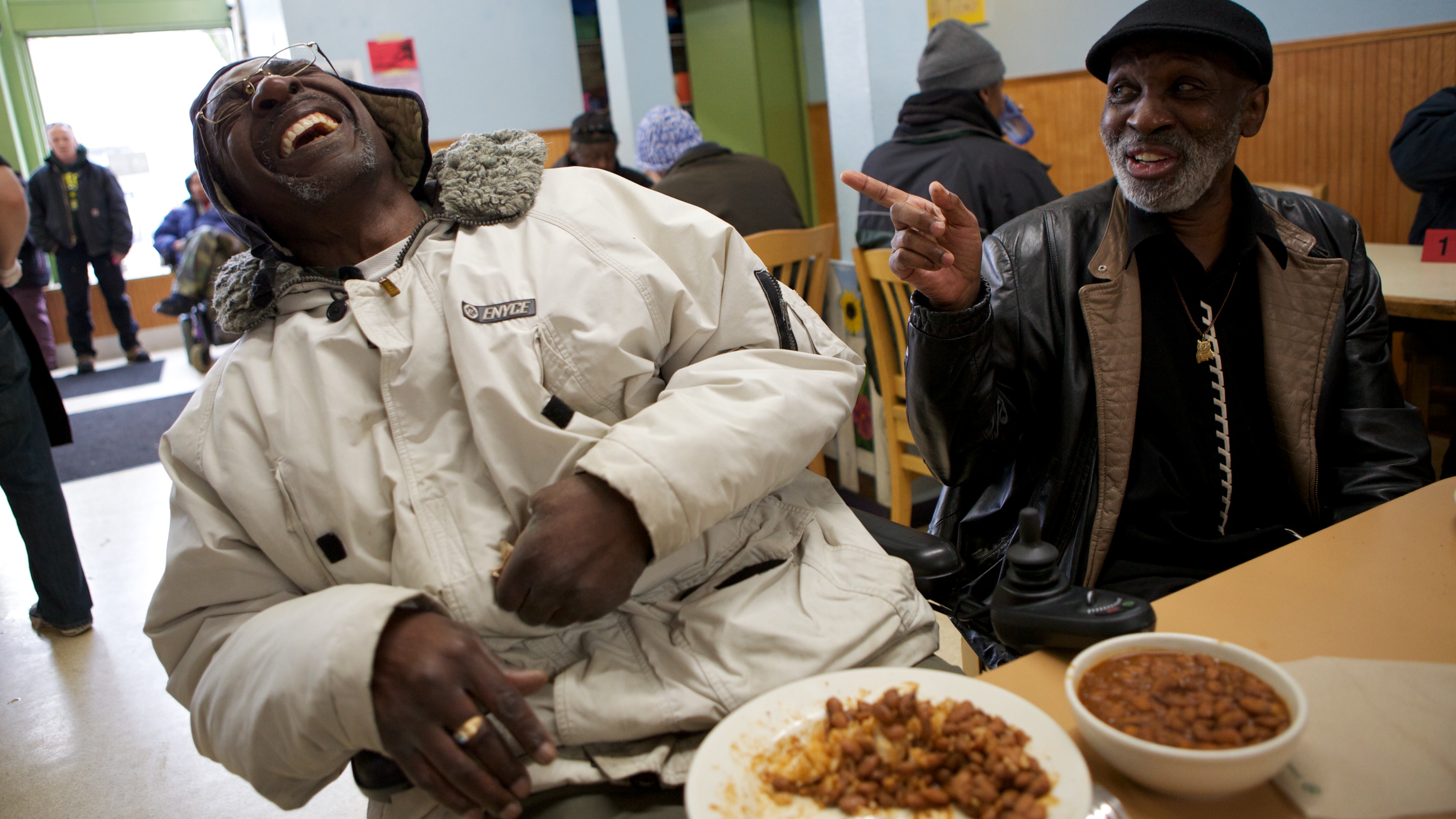
 [Image: photo from inside Sisters of the Road nowadays. The cafe has nice wooden chairs now and the lovely old wooden siding still. Two apparently African American men but they could be islanders or African of course, also they could be transmen, I don't know them personally, anyway they are in the foreground and the one who has my favorite red beans and rice in front of him is laughing uproariously with his head thrown back. The one with him is pointing at him with a big smile as if to say "gotcha." The one who is totally laughing has a powerchair which you can see the controls. Other diners of a variety of skin tones, gender presentations, ways of looking, etc. are throughout and the place and people just still seem as welcoming and friendly as I remember.]

Which brings me to this too: It was very rare back then to be able to get vegetarian food, but they always had it in addition to hearty meat dishes. They also had this kick ass Puerto Rican salsa, because one of the steady volunteers or workers was from there and knew how to do it. (People who really worked there for a wage or were steady volunteers did not act better than anyone or better than each other. You could pick them out only because they worked for longer than 15-30 minute stretches.) Nobody sneered at vegetarianism and said, “Beggars can’t be choosers.” I am sorry that so many religiously based organizations at that time (late eighties; I wouldn’t be shocked if it’s the same now) had personnel who liked saying that demeaning bromide when I shyly asked if there was peanut butter at all, but I wasn’t just being picky. My vegetarianism is long-standing and stems from deeply held personal beliefs.  And even if I were just being picky, why rub it in that someone’s life is hard if yours is a bit better and you are allegedly trying to help?

Genny Nelson was the boss of Sisters of the Road at that time and also later when I was more on my feet and came back around (she is retired now). She was there a lot and rolled up her sleeves and pitched in. She had been one of the inventors of it and when inventing it what she and her partner had done is asked around and found out what would be useful and good for actual people and what would not. I do not know if she had heard the slogan “Nothing About Us Without Us” but she sure did live by it and also create an organization that was founded on it, as well as the true meaning of Caritas, which is the root word for “charity,” which, as I said, is the Latin translation for Agape, rendered well in English as unselfish love.

So Sisters of the Road is earmarked for homeless people, many of whom are Autistic and otherwise neurodivergent, partially because a lot of the big alleged charities for Autistic folks do not provide much real life help at all, so good people who want to help others are accidentally throwing their money to the greed machine while the people they wanted to help are left floundering.

The straight up Autism charities that exemplify Nothing About Us Without Us are actually run by Autistics. These are Autism Women’s Network (AWN) and Autistic Self Advocacy Network (ASAN).  Autism Women’s Network is working on getting together some more on-the-ground initiatives, to get money and resources back to the right people who need it. Autistic Self Advocacy Network has created a sea change in the way Autistics are able to see ourselves and come together in action, as well as carve a place for ourselves at policy tables, even at the very highest levels. This has literally changed the world for me and many people I know. I think ASAN is also looking into a grants program. Both of these groups increase our dignity and well-being every day without wasting good people’s money lining greedy pocketbooks or financing harmful ad campaigns or research into preventing us from being born. Both of these groups are bona fide what a charity should be, and growing and doing more every moment of every day with your help.

Back to Sisters of the Road: Sisters of the Road, I salute you. The xxx symbol someone anonymously chalked onto the sidewalk to denote good food and hospitality in hobo code was apt and true and I will love you forever. Readers, if you give them a little bit of money too, there is no way you won’t be helping some Autistics, because so many of us are pushed through the cracks into poverty and homelessness at some point in our lives.

Here is their website: http://sistersoftheroad.org/ . Love!

Thank you for listening.

Love, Ib

Friday, November 1, 2013

Autistics Speaking Day: I Speak To Thank

Today is Autistics Speaking Day, which has a rich and sort of unfortunate history.  I haven't got long to write, but what I have to say is big and cannot be unsaid on this day.

The rich unfortunate history has to do with people going About Us Without Us, and when some of our own tried to say something about it, these 'do-gooders' seemed to express, to put it charitably, irritation. What they did not seem to do was listen, at all, even though they said they were doing whatever they were doing for our own good. We are doing this for your own good lalala hushup you ingrates we can't hear you... 


[Visual is the red-circle-with-a-slash symbol of crossing-out, being itself crossed out by a bigger symbol of the same shape backwards done up over it in rainbow colors. Superimposed on this are the words "Autistics Speaking Day Nov 1 2013" in writing suggestive of how monks illuminate manuscript.]
But I know many people who not only listen but go so far as to seek us out and amplify, and they are basically in three communities, and I am hoping to introduce many of them to one another at TASH if I can, or get started here, and on the other blog NeuroQueer, which others of them are more likely to read, and all of you, see how I switch pronouns here, but I do it on purpose for a change: all of you are beautiful, and I thank you.

You who listen and amplify are some of you parents whose children also are Autistic, and you wanted to find us, and you were not so busy trying to find ways we could not possibly be like your child that we should be invisible forever: so you sought and found us, and you are our beloved friends.

You who listen and amplify are some of you scholars, scholars with other disabilities, queer scholars and scholars of color, community scholar activists who did not just brilliantly theorize amongst yourselves about how we were not at the table: but you decided to get it started and do something about it, and you are our beloved friends.

You who listen and amplify are some of you people of practice, people whose life work is devoted quite literally to making sure the voices of some of the most vulnerable and invisible among us are able to be found and witnessed, and sometimes you are hardly seen, and sometimes you are mistreated and disrespected by bigots who call themselves greater and more acceptable things, but they are not. You are greater, and the greatest: you put yourself on the line for us and our voices, and you are our beloved friends.

When I first decided to write about this I was going to name your names, and I hope you are not sad that I did not, because for me the reason is so happy that tears of joy spill softly from my eyes now. In this small time of being myself in the open, and in community, I have met so many of you. The movement of Disability Justice even only when considered in the Autistic Community has so many true real Allies who are heart and brain and hands, and you who are reading this know you are my beloved friends and know who you are, that my babies would wake up and get hungry if I tried to list all your beautiful selves separately.

And anyway, we are not separate. We are joyously together.

Thank you, my friends, for caring that we speak.

Love,
Ib

Tuesday, October 1, 2013

Workarounds Are Our Friend

Some of the excellent answers on the last blog post about crossing the street, which I'll repost HERE in case you didn't get a chance to read the comment thread, led me to write this other article about workarounds.
[Visual is a graphic drawing of a hammer superimposed on a blueprint, with the words "Workaround Workshop" surrounding the image.]
Everyone learns differently, and when you're teaching things to people, remembering to presume competence, it sometimes comes to the attention of both of you that there is some kind of real block against that particular type of thing.

A word about presuming competence.

To presume competence is to give someone the benefit of the doubt instead of just saying, Oh, Alas, This Person Is Obviously Incompetent In Every Way And Practically Not Even Here. Because your person is more than likely there, and can hear you do this.  I talk about that some length HERE toward the end of this article. But on the other side, it also doesn't mean assuming anyone is a magic superhero who is terrific at everything. Nobody is like that.  Autistic people such as myself often have particular areas which are super extra hard for us, and we cannot get past a wall in them. That is what some of the commentators in that last post were talking about, and what I can talk about in this post, regarding time.

And it brings us to Workarounds. Workarounds are our friends.  Workarounds are what you come up with to get around, over, or some other kind of way past that wall instead of bashing your head against it.

I'll talk about myself.  Time is a thing I do not really get properly, despite the fact that I can appear to "tell time" although I am not very rapid at it.  I can read to you off an analog or digital watch.  I also always wear one because the alarms are helpful for me.  But I do not feel time elapsing in the proper way, and I am sure this is the case because I have interviewed many people about the real way time is supposed to feel.  From my perspective, time seems so arbitrary as to be fake, like a trick.  When I wrote THIS, I was doing what my grandmother called "kidding on the square," which is kind of joking, but kind of telling the truth.

It is not as if I was never taught how to tell time properly.  I was.  As a matter of fact I have such a deep and vast knowledge of time-telling pedagogy that I can teach teachers how to teach time-telling very effectively to a wide range of children and this is a huge part of my job.  It is just that there is a block in my brain about it for some reason.  I have other friends who are opposite of that, who can tell time better than clocks.  If you had a clock and Bridget who blogs HERE saying different things, you should fix your clock.

So now I come to the Workaround.  Whatever it is that you or your kid just can't seem to get past, be it crossing the street without a light because it feels like mindreading cars, or having a feel for time, there are ways around it.  Come up with plans and you will be golden.

For me, I get that commercials are shorter than movies, so I have some sense of not saying "I'll be back in a minute" if I am going to do something that is more like going to a movie than the time span of a commercial. And a ball game is longer than a movie, so. Another part of my workaround system is technology.  I have a lot of gadgets helping me, alarms, talking computer, etc.  People help me too.  Since I am a professor and people look to me to be in charge of when break-times and things are, I openly tell them it is OK to remind me, and I tell them why, but I also use great software for the iPod like the Visual Timer that is quick and easy to customize and set and doesn't make noise. In airports, I alert the flight personnel that I am there so I don't space out too much and miss the flight. They are very kind about this.

Another thing I do is try to be early rather than late, but to be honest time is still a large source of anxiety since it is a thing that I am relatively clueless about. When I get the chance to be interdependent about it instead of trying to rely on all my own self, I am much more relaxed, and that's OK today. It wasn't always. I wish I had learned this younger.  This is different from learned helplessness.  I am not helpless; I am getting help for myself in real ways that will really work, and in turn I am helpful to others in other ways that play to my various strengths. I just no longer have to injure myself out of false pride, because I now understand that I don't have to try and act "perfect" all the time, which just breaks me down and makes everything worse.

So if you are a parent or a teacher, you might be able to help younger kids who are Autistic find out workarounds for themselves based on checking out what they are good at and what they are interested in and tying that into a way to get success working around the problems of what is not happening for them, which in my case is time and in some other people's case it might be recognizing faces or what not. Or crossing the street.  You could decide to really always cross at lights, or when there are no cars.  You could live in a neighborhood with either very busy streets (to ensure lights) or non busy streets (to reduce likelihood of cars) if that was your lifestyle.  Things can be worked around.

If you are an Autistic self who is trying to find workarounds for your self you can ask trusted friends to help you make a list of things you are good at, in case the topic is stressing you out. They might be able to see connections that will cause you to come up with excellent workarounds together that would not have been thought of alone.

Some friends and I have a whole website called We Are Like Your Child which is largely devoted to workarounds, but also partially just to showing that we who have pretty insurmountable sounding problems are willing to go out on a limb to talk about them now because we get the message that the successes we have fought for make our lives seem unattainable to some people, on behalf of their children, who are having a hard time now. But we were like that, and we wanted people to know.  The link takes you to an essay of mine because I know I wrote an essay specifically about workarounds for the social and sensory issues surrounding why it is so hard to go to a party.  I know if you click around there on that site there are other great workarounds mentioned like ways to organize.

Everybody, I want to thank you.  This has been great. I hope more people will ask questions like this and I also hope more and more people will share their own experiences in the comments because our experiences are different and similar and all very telling.  Experience is the richest place to find questions and answers and it also makes our community strong.

Love,
Ib

O & PS So this is my invitation to put your favorite workaround into the comments below!! :D

Monday, September 23, 2013

Crossing The Street With Neither Guard Nor Signal

Dear Ibby, 
So I have what should be a really simple question to answer, and yet...maybe not. 
It's about crossing a busy crosswalk without adult assistance. My 12-year-old son just started middle school; to get him there, I drop him off at a busy corner with a crosswalk. Only difference from elementary school is that there's no crossing guard. 
This morning, he was the only one in the crosswalk, and with my "cross safely" ringing in his ears he...stopped. Waited for the cars there to go. They waited for him. The drivers started waving him across. But he, of course, was not looking at the drivers. He was just waiting. Honking started. I finally rolled down the window and said, "OK, go ahead, safe to cross!" And he, without looking first to be sure nothing had changed while I said that, darted across. Something about the whole thing worried me. 
My question then: How do I teach him to look INSIDE the cars to see if the driver sees him, if the driver is waving him on, if the driver is NOT seeing him and is about to drive forward, etc.? This is going to come up when he starts to drive, too. Is there a simple way to address this tendency to just think, "the rule is that I can go when there are no cars at the crosswalk" or something like that, and not to adjust depending on the situation? Most mornings, he won't the be only one crossing. But when he is...I need him to be safe, and I can't think of a single simple "rule" he can use; the situation is always different, and I won't always be situated so I can direct him from my own car. Ideas? And THANK YOU.
Lori 
[Visual image of an official DOT crosswalk sign, person in silhouette crossing street on yellow background]
Dear Lori, 
This is a great and useful question that is the opposite of a simple question! You are right! Should be: isn't.
So I wracked my brains trying to remember how I found out about looking inside of the car to see if they can see you and whether they are going to run over you about it, and could not do it by myself. So I called up the person who would have taught this information to me! (This is the key to good research skills, by the way. If you know who knows, it's as good as knowing it yourself.)
My mom said it made total sense to not want to be embarrassing him by being the hand-holdy mother all draped over his business if there are other kids around, but when there are no other kids, this will work better with you not in the car, because he can follow your head with his head and hear your words up close.  You narrate with him what to do, always using the same words, never changing it up.  "Look left, look right, look left again. Are there any cars? Neither side? Safe to cross. A stopped car nearby? Look inside. Can the driver see you? How do you know? Smiling and waving and not going? OK to start. Now look back right. A stopped car? Can he see you?" Etc. In the car on the way there you can do this decision chart. He will know it in his head when he is with the other kids and you can hide and watch from your car to feel better, but he should get it pretty soon and get comfy.
When my mom was telling me about the above I started remembering it, the rhythm of it. As a matter of fact my mom had to get off the phone pretty quick but I suspect she stealthily slipped a bunch of good manners information into these rhythmic safety algorithms. (As you are reading this, Mom, note that I gotcha.) Because I have a dim memory of this being around the time I learned the thank-you wave that I still to this day use while I myself am driving, or when I do have the pedestrian right of way on a crowded urban turn lane and the driver did smile and wave me through, but it is still nice to acknowledge not being run over.
I am a very safe walker and driver now, and polite, and also very good with algorithms such as who goes where on a broken signal light. I am, astonishingly, not the one who gets confused in such situations.
Neither will your son be.  There is a bright side to all of this.  :)
(In other related news: Another thing I have to remember to this day is how to act like I am trying to cross the street instead of trying to randomly loiter in the general vicinity. This is another issue I don't know if he has, but it might be a thing.  Look purposeful about I Am Crossing The Street Just So You Know and the car drivers will be more likely to Take Notice.)
Write back and let me know how it all goes?
Love, Ib
O and PS: If this is not quick enough, remember that you can buy time by rousing the neighborhood and agitating for a traffic light.  Let me know if this is something you want to do and I will put you in touch with some people who have done it and know exactly how to make it happen.
 

Friday, September 6, 2013

Media Throws "Autism Parents" Under The Bus Again

Another incredibly self involved person without a moral compass tried killing her kid. This time it didn't work, thank heaven, but members of the media as well as key "parent" bloggers are as usual taking the opportunity to present the grisly, unnatural and horrific acts as somehow logical, to further their complex and spiteful agenda.

They are callously using these troubled criminals, in other words, and calling them "typical parents" doing "understandable acts of desperation" at the expense of real parents everywhere. Don't fall for it, and don't stand for it. Speak out.

Thought experiment: You hear a news report that a promising young high school football player with a scholarship to Notre Dame after graduation was gunned down in cold blood by his mother. It comes out that she had called, even taken time off her minimum wage job so she could try in person, begged at least seven times for more food stamps because Jim's training schedule started making him so hungry she could no longer afford to feed him. They ignored her. She is quoted as saying she saw no way out but to kill him: Julie had known hunger, and vowed her boy never would.

Now. Are we going to be deluged with crap blaming the boy for being inconvenient, or will we be shown a lovely pic of him as a heroic young life cut short?

Will she be painted as society's victim, one of us? Or perhaps...someone who killed her own child: a child-killer. The very worst kind of criminal we can think of. She's poor and the kid was not disabled, so...

I'll stop with that. But you see why I'm so sick. Wrongness is happening on so many levels and not just to Autistics. They are doing this to our parents, and our whole civilization.

Please stand with us and say NO in any way you can think of, every chance you get.

Evil is NOT the typical response to being under resourced. We cannot allow this myth to take hold and dig deeper cultural roots.

In short: we need more resources and that is the truth. But most people would never kill an innocent kid, no matter how hard life is, and to say otherwise is a flat out lie.

Thanks for listening.

Love,
Ib